|
<< Click to Display Table of Contents >> Setting Up the HearAid Database |
  
|
|
<< Click to Display Table of Contents >> Setting Up the HearAid Database |
|
The Database & Analysis settings in Tools|Options are vital to the proper function of HearAid and access to the database, both on a single computer and across a network. It is essential that these settings are correct!
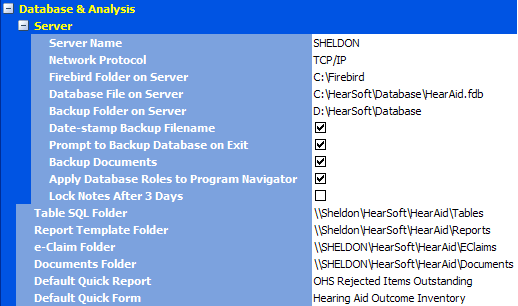
Server:
The Server settings should be configured directly on the server computer, to avoid confusion over folder names and paths!
•Server Name: This setting determines where HearAid looks for the data. In a LOCAL or LOCALHOST configuration, the database is on the same computer as HearAid and it will not be accessed by other computers; if any other name or an IP address is used, HearAid assumes it is running in client/server mode and looks for the database server connection on the named computer. If that computer is not running the Firebird server (either as a service or an application) HearAid will not start properly! The Server Name can be either an IP address such as 192.168.0.2 or 127.0.0.1 (ie LOCALHOST), or a valid network name such as SERVER, FRONT_OFFICE, LINDSAY, etc. See the Firebird Database Engine topic in the HearAid on-line help for further information
•Network Protocol: The Firebird Database Server can work in client/server mode using either the TCP/IP protocol, or NetBEUI. As a general rule, we recommend using TCP/IP as your network protocol
•Firebird Folder on Server: If HearAid is running in a client/server configuration, the Firebird Database Server will be installed on a "server" computer (ideally a dedicated server computer which is not in active use). HearAid needs to know where Firebird has been installed on the server so that it can access several vital files. This folder setting must refer directly to a physical drive on the server (eg C:\Firebird) and must NOT use a mapped network drive name (eg Z:\Firebird, where Z: is a mapped network drive) or UNC path (eg. \\Server\Drive C\Firebird, or 192.168.0.2\Drive C\Firebird)
•Database Path on Server: This must be a real path to the HearAid.fdb file on the server. If the default installation has been used, the path will be C:\HearSoft\Database\HearAid.fdb, but in the example shown here it has been located on a second physical drive (drive F) on the server. This setting will also allow an database with a different name to be used instead, as long as the structure of that database is identical to HearAid.fdb!
•Backup Folder: This folder specifies where HearAid will put its backup file. In client/server or LOCALHOST mode, this must be a real path to a folder on a physical drive on the server. In LOCAL mode, this can be any real folder, even one on another computer on the network
When specifying folders and file paths, it is advisable to use the drop-down folder tree list box to navigate to the correct folder or file
Once all the Database & analysis settings have been set properly and saved, the settings are stored in Firebird.ini in the same folder as HearAid7.exe (..\HearSoft\HearAid for the default installation). Firebird.ini can then be copied to other computers on the network if it is planned to install HearAid7.exe on the workstations in order to reduce network traffic.
•Users Own Report Templates: Users can have their own set of report templates, rather than having all users share a common set of templates. This setting is mainly intended for practices using Terminal Services or a Virtual Private Network to access HearAid, so that remote users can customise templates to suit the needs of their own site
•When setting the Table SQL, Report Template and EClaims folders on a network a UNC Path should be used
•To set the UNC Path to a folder on the server:
1.Click the button at the right-hand end of the edit box

2.Navigate to the folder on the server via Network
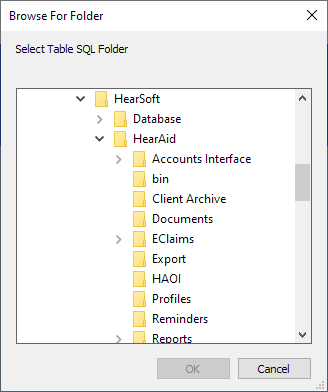
•Tables SQL Folder contains SQL scripts used when HearAid connects to the database. Generally there is no need to add extra scripts to this folder other than those installed with HearAid
•Report Template Folder: Tells HearAid where to find Report Templates (whether or not they are common to all users or separate for each user. Network installations must use a UNC path.
•e-Claim Folder: This folder is where HearAid looks for batch files to upload and response files to reconcile. Network installations must use a UNC path. HearAid will not look anywhere else and all batch files and response files MUST be stored here
•Documents Folder: Tells HearAid where to find scanned and other documents linked to Documents. Network installations must use a UNC path
•Default Quick Report: Sets the Quick Report template which is run if the Quick Reports button on the toolbar is clicked, rather than the drop-down button
•Default Quick Form: Sets the Quick Form which is generated if the Quick Form button on the toolbar is clicked, rather than the drop-down button